Implications of RTI for the Reading Teacher
I love how this article opens up; “It isn’t your framework.You’re just aggressive about kids’ learning.” and as the article goes on to state,
No instructional method, approach, technique, strategy, or scheme has ever been found to be 100% effective. Even in the most advantaged and highest achieving school districts some students struggle;
RTI tries to make sure that classroom teaching is “up to snuff” and that when a student does falter, there will be a rich, and ultimately, sufficient instructional response to his or her reading needs.
As it pertains to reading, Reading teachers should have a substantial understanding of the developmental continuum of learning to read. How else can we expect them to assess and recommend intervention!? They should also have a firm grasp of sound assessment strategies and procedures!
Reading teachers can have a tremendous impact on the trajectory of a student if the teacher understands the core reading skills necessary and how to assess students and intervene!
RTI is a fundamental framework for reading, as a core skill set for budding students!
Response to Intervention (RTI): What Teachers of Reading Need to Know
The second article is a wealth of information on how to appropriately execute RTI in the classroom for Reading! As well as the science behind the framework!
A 5 step process:
1. Screen students, what do they know?
2. Scientifically valid interventions for applicable student base are implemented.
3. Monitoring of student progress based off of intervention.
4. Individualized interventions for students for whom interventions have not yet worked well.
5. Deciding as to whether a student requires special services outside the scope of the classroom.
RTI works because it is a focused and iterative process which builds on the success of intervention or at the very least is on top of student intervention based on assessment and changes intervention or escalates.
Sunday, December 9, 2018

Saturday, December 1, 2018
ELL Case Study - Interviews
My Pre-Writing
Assignment Interview with the teacher (Devorah B.)
Me: Hi, Devorah, Thank you again
for letting me participate in your classroom and observing your ELL student
Yakov. I am going to be interviewing you about your ELL experience, and taking
notes.
Me: Please describe your
ELL teaching experience.
Teacher: I have been a teacher
for close to 15 years, I have had a few ELL students, not every year though.
Most of my ELLs have been from Israel and Russia.
Me: What is your perception
on ELLs in terms of their learning motivation and performance? What learning
difficulties do ELLs usually encounter in schools? What is the role of family
and community in helping ELLs’ learning?
Teacher: Wow, Ok. That’s a loaded
question, I will try to answer it one at a time. My Perception of ELLs really
is, some are very very motivated but some are just too overwhelmed, I guess
there is little middle ground as you would find with non-ELL students. In terms
of learning difficulties, ELLs really have all the cards stacked against them,
they don’t understand the other students, they notice that the other children
do look at them a little different. They don’t understand other teachers or
parents, they are usually adjusting to a whole new world, all of this can be a
lot on a young child. So that segways into the last part, community and family
mean everything to ELL students, for most students community and family mean a
ton, but without family and community support my experience is that ELLs just don’t
do well at all.
Me: In your opinion, how do
classroom teachers resolve ELLs’ learning difficulties? What strategies do you
adopt? Are they effective or not? Do you participate in on-going professional
training for teaching ELLs? What is your experience in terms of working students
from diverse cultural and linguistic backgrounds? How do you make sure that
your teaching is culturally responsive? How do you go about reaching out to the
family and the community?
Teacher: There is a lot which teachers do, the most
important of which is to make the ELL feel comfortable, include their language
into signs, books and the like. This school requires us to stay on top of the
latest in teaching, including training for ELLs. In terms of culture, the
cultures I deal with are very similar, given that this is a Jewish private
school, but there are some cultural differences between Americans, Israelis and
Russians and it is very important to understand those differences and be sensitive
to the other cultures. I reach out to all of my families, but make a concerted
effort when a student requires special consideration such as an ELL.
Me: If you have an ELL in
your class whose culture you are not familiar with at all, how do you go about
teaching the child?
Teacher: We are given the roster
before school starts, and I am made aware of all special considerations. When I
had my first ELL, an Israeli boy, my principal pulled me aside and walked me
through some of the challenges. She was very involved throughout the school
year to make sure I handled the situation and that I was sensitive to the
students culture and disposition.
Interview 2 with teacher, Post Writing Assignment
Me: Please describe the ELL’s performance after
participating in this project.
Teacher: Rebecca, first, I really appreciate the work
you are doing with Yakov, and I feel a little sad that you are done with your
observation hours, can’t you come back some more? Yakov loves you!!!. Yakov has
been doing fantastic he really is making such great strides!
Me: Devorah, you are too kind. Although, you may
have answered my question, for the record, In your opinion, how did this
partnership affect the ELL’s learning performance and motivation?
Teacher: It has been fantastic, you really made a
difference, so please don’t leave Yakov!!
Me: What did you learn from this school-university
partnership model?
Teacher: I am not sure I understand the question? Can you
paraphrase?
Me: I think the question is, what did you learn
for me, as a student, partnering up with you to help with Yakov?
Teacher: I learned a lot from you Rebecca, let’s see, I
had not done a SOLOM before, I also loved hearing about the different types of
work you were learning in class, and I think we may try a readers theater! That
looked like a lot of fun and I appreciate that lesson plan you gave me.
Me: What difficulties did you encounter in this
school-university partnership model?
Teacher: To be honest, you are leaving now, and it is
going to be rough on Yakov, even though he has his ESL pull outs, he really
took a liking towards you, and he loves that book you guys made, so please
stay!!!!
Me: What would you suggest to improve the
school-university partnership model?
Teacher: Aside from forcing you to stay all year? I am not sure, it worked out really nicely I don’t have any real suggestions.
Teacher: Aside from forcing you to stay all year? I am not sure, it worked out really nicely I don’t have any real suggestions.
ELL Case Study - Observations
The Writing Activity
I worked with my teacher (Devorah B) to come up with a writing
activity for Yakov. We decided to create a book “Yakov Yakov What Do You See”
based off of “Brown
Bear Brown Bear” by Bill Martin. We were going to build up to this activity, first
Yakov needed to get the basics of reading and writing English. We planned for
the activity to take place in the middle of November (A little less than 9
weeks from when we started)
Observation 1
I sat with Yakov as he
worked in a small pull-out group with the ESL teacher. There were six students
in the group. The teacher was working on the CVC pattern to write new words,
review old, and combine both the form sentences. Yakov had been taught short
vowel sounds but had difficulty enunciating some of them especially the “E” and
“I”. He had been taught the consonant sounds but had trouble differentiating
between the B and D. He attempted to read words that the teacher had on a
chart, such as pin, pen, and pan. He really worked on it, finally said them,
wrote them, and drew a picture for each. The teacher had a color chart with
each color word written in that color. Yakov was able to say each color. I was
not sure which clues used to say the color, but I believe it was the visual
clue of the color itself.
The teacher had sentence
strips, each child worked with a partner to read the strips quickly. Such as “Yakov
had red pens. Felix has blue pins” were read. Each child then took two sentence
strips from the pile, Read it, wrote it in his notebook, and illustrated it. Yakov
completed this task happily. The teacher then gave out more complicated
sentence strips. Some examples “The six green pens are on the yellow Pan”. Once
again small group work was done. The teacher went to each group questioning the
children. I observed that Yakov was able to write English with minimal level of
proficiency since he was using restricted vocabulary and difficulty pronouncing
the vowel sounds. At this point I completed the first SOLOM proficiency
assessment and the first writing rubric. Yakov was at the beginning level
on most of the language skills. His listening skills were a little beginning;
he was able to comprehend individual words and some common simple short
sentences that the teacher said. He can understand simple commands and relied
heavily on visual clues. He did understand what he had learned before, but when
the teacher began a few minutes on a new topic, he had trouble. The ELL teacher
began a new book an introduction to the book “To the Rescue” by Cecile Schoberle;
she was beginning a unit on rescue and safety. She introduce the word rescue,
demonstrated how she saved a stack of books from falling. She showed how she
rescued or saved a boy from tripping over a garbage can.
Observation 2
I sat alone with Yakov we
did a walk-through and picture walkthrough of the book “Brown Bear Brown Bear”
by Bill Martin. After much repetition he was finally able to say brown bear
brown bear what do you see? and I see a... It took a while for him to really
understand the picture of the bird, when I told him “ptitsa” (bird in Russian,
thank you Google Translate) he smiled, repeated ptitsa and said bird. For the
word duck I said quack quack he was not sure about a duck but he said the word
“duck”. I then used my laptop to show him the new vocabulary. Repetitive
structure made it a perfect book for Yakov. I also showed him a short video of
the book on YouTube which was a song by Greg & Steve (https://www.youtube.com/watch?v=rTva3KkhxUA)
with the words on the screen. He
pointed to the words as they were sung. I also reinforced the colors that he
had learned in ESL. He also listened to the book read on YouTube as he followed
from my copy. He was all smiles as he felt success singing along and then
reading along.
Observation 3
I continued with the
theme from the previous week. Yakov reread the book “Brown Bear Brown Bear…” He
used picture clues to say the words that the animal saw and tried to say the
colors. I then gave him index cards with just colors in words only written.
Another set of cards had the names of the animals. Using the book, he matched
the color with the animal. He then illustrated one after he wrote the words. He
enjoyed meeting success in the activity
Observation 4
When I worked with Yakov
I asked him to review the book “Brown Bear Brown Bear” he was able to recall
most of the colors but not all of the animals. The word children he couldn't
get and said boys, having used visual clues. The same with mother he said mommy.
However there was quite an improvement over our first visit with the book.
Observation 5 and the
writing activity
I worked with Yakov to create
his own book called “Yakov Yakov what do you see”. Before we wrote anything we
worked very hard for him to verbalize something that he saw. Finally he said “I
see a cat looking at me”. We then said “cat cat what do you see: and Yakov said
“I see a dog looking at me” the repetitive language was great. He then tried so
hard to write using the book as a model and wrote the first three parts of his
book. He illustrated it; he took his book to all his peers and teachers to
proudly read it to them.
Observation 6
I re-administered the
SOLOM he had improved so much he had much more confidence and was very willing
to try new things.
Thursday, November 22, 2018
Week 12 Assignment #1
Summary of Technology to Support Literacy
"In this age of multimedia, a new kind of storytelling has emerged. Digital Storytelling takes the art of storytelling and adds elements of sound, video, and photo images to create a multi-dimensional tale that draws the reader into the story. It's an excellent tool to encourage students to take their writing to a new level as well as a way to bring technology into your curriculum."
The above quote is from scholastic.com; it is an excellent starting point, but not the entirety of technology and how it can support literacy. It should be much more. Technology is best used as an integrated tool which incorporates student interaction and engagement. An excellent example of that is starfall.com. More than just watching an interesting video or photos.
I found the article/brochure from from the Reading Association to be almost prophetic. It is ironic, reading an article about technology, to learn about supporting literacy by using technology; however published in 2001; which in the technology sphere, is, well, put it this way, it was 3 years before Gmail launched.
Anyways, the article itself proved to be on point: "To become fully literate in today's world, students must become proficient in the new literacies of ICT. Therefore, literacy educators have a responsibility to effectively integrate these technologies into the literacy curriculum in order to prepare students for the literacy future they deserve."
The types of technology which I integrate into my classroom, include: internet multimedia platforms (youtube, vimeo etc..) as well as interactive applications, such as starfall, and virtual field trips using museum websites and google maps!
My lesson plan for Kindergarten Students, reading the book “The Very Hungry Caterpillar” by Eric Carle
and technology integration!.
https://docs.google.com/document/d/1KuUPeqIJnN1zZA1SLWu2m7MVSFhddQMbHc7zqdyp5bs/edit?usp=sharing
"In this age of multimedia, a new kind of storytelling has emerged. Digital Storytelling takes the art of storytelling and adds elements of sound, video, and photo images to create a multi-dimensional tale that draws the reader into the story. It's an excellent tool to encourage students to take their writing to a new level as well as a way to bring technology into your curriculum."
The above quote is from scholastic.com; it is an excellent starting point, but not the entirety of technology and how it can support literacy. It should be much more. Technology is best used as an integrated tool which incorporates student interaction and engagement. An excellent example of that is starfall.com. More than just watching an interesting video or photos.
I found the article/brochure from from the Reading Association to be almost prophetic. It is ironic, reading an article about technology, to learn about supporting literacy by using technology; however published in 2001; which in the technology sphere, is, well, put it this way, it was 3 years before Gmail launched.
Anyways, the article itself proved to be on point: "To become fully literate in today's world, students must become proficient in the new literacies of ICT. Therefore, literacy educators have a responsibility to effectively integrate these technologies into the literacy curriculum in order to prepare students for the literacy future they deserve."
The types of technology which I integrate into my classroom, include: internet multimedia platforms (youtube, vimeo etc..) as well as interactive applications, such as starfall, and virtual field trips using museum websites and google maps!
My lesson plan for Kindergarten Students, reading the book “The Very Hungry Caterpillar” by Eric Carle
and technology integration!.
https://docs.google.com/document/d/1KuUPeqIJnN1zZA1SLWu2m7MVSFhddQMbHc7zqdyp5bs/edit?usp=sharing
Thursday, November 15, 2018
Week 11 Assignment #3
Reflection on Teaching Expository Text Structures to Facilitate Reading Comprehension
The entire point of expository text is to inform, or teach the reader. The author of the text will use structure in his or her thinking. It is therefore crucial for the reader to be able to understand the structure in order to follow the authors line of thought and to comprehend the text! Like everything in reading comprehension, the more the reader can focus on understanding the text, and not trying to decipher structure, the more the reader will be able to understand.
A great tool for aiding in teaching students how to think about text structure is a graphic organizer!, which segways into the next part of the assignment : mini-lesson plans using graphic organizers!
Mini Lessons
Thursday, November 8, 2018
Thursday, November 1, 2018
Week 9 Assignment #3
The Qualitative Reading Inventory-5 is intended for students K-12. It can be used to provide appropriate information
to identify a student’s instructional level, determine areas of reading in which the student is having difficulty and to document growth based on a type of instructional program or intervention.
When used to determine a student’s reading levels, the QRI-5 can help find the levels
at which a student can read independently, read with instructional guidance, and read
with frustration. The QRI-5 can also be used to determine if a student’s reading levels are
below his or her chronological grade level.
DIBELS - Dynamic Indicators of Basic Early Literacy Skills are
formative early literacy assessment was created by Dr. Roland Good and Dr. Ruth Kaminski of the Dynamic Measurement Group - they have since renamed it Acadience Reading. They are a set of procedures and measures for assessing the acquisition of early literacy skills from K-6th grade. They are designed to be short (60 seconds) fluency measures used to regularly monitor the development of early literacy and early reading skills. These assessments are performed using a computerized handheld device like a smart phone.
DIBELS are comprised of seven measures to function as indicators of phonemic awareness, alphabetic principle, accuracy and fluency with connected text, reading comprehension, and vocabulary. The measures that encompass Dibels are Initial Sounds Fluency (ISF), Letter Naming Fluency (LNF), Phoneme Segmentation Fluency (PSF), Nonsense Word Fluency (NWF), Oral Reading Fluency (ORF), Retell Fluency (RTF), and Word Use Fluency (WUF). DIBELS were designed for use in identifying children experiencing difficulty in acquisition of basic early literacy skills in order to provide support early and prevent the occurrence of later reading difficulties.
Differences: DIBELS and QRI-5 :
1) QRI-5 goes until 12th grade while DIBELS only until 6th.
2) DIBELS also has a time limit for each assessment, which 60 seconds. The QRI-5 also has some timed assessments but they are not used on all grade levels.
3) The QRI-5 and DIBELS are designed to identify students having difficulty in achieving basic literacy skills, however, DIBELS is more specific; it assesses issues such as phonemic awareness, alphabetic principle, accuracy and fluency, vocabulary, and comprehension. The QRI-5 is a little different; it has word lists, concept questions (accessing prior knowledge), miscue analysis, retelling, and comprehension questions.
Similarities
1) Both the QRI-5 and DIBELS are used to identify reading levels and match students to suitable text, to verify a suspected reading problem, to determine strength and needs of a student, and recommend paths for interventions.
Both QRI-5 and DIBELS can be used in the classroom in the beginning of each year in assessing what each student's fluency, comprehension, phonemic etc.. levels is and for determining how to best intervene with a student if need be. They also are critical in determining whether interventions are working and how well students are progressing. As teachers we must have a very good understanding of how well our students are reading in order to properly address each students needs!!!
Thursday, October 25, 2018
Sunday, October 21, 2018
Week 7 Assignment #5
Hi, I assessed a young boy, Moshe, who is in 1st grade.
Print Awareness
*He did very well he was able to identify:- ✔The front of the book
- ✔The title of the book
- ✔Where you should begin reading
- ✔A letter
- ✔A word
- ✔The first word of a sentence
- ✔The last word of a sentence
- ✔The first and last word on a page
- ✔Punctuation marks
- ✔A capital letter
- ✔A lowercase letter
- ✔The back of the book
Moshe did excellent!!
Phonological & Phonemic awareness
I think phonological and phonemic awareness confused Moshe a bit. While he had a great intuition, I do not think he understood the formal terms.
For example if I asked him "how many syllables were in the word beginning" he knew there were three but he did not know what I meant by a phonemes. I explained it to him and he did very well for someone who was never explained the terms. we visited the page from readingrockets http://www.readingrockets.org/teaching/reading101-course/modules/phonological-and-phonemic-awareness/phonological-and-phonemic#inter and listened to the different blending phonemes and I showed him the different markup for phonemes! he really enjoyed the activity
He was able to do Phoneme matching, Phoneme isolation, Phoneme blending, Phoneme segmentation however Phoneme manipulation was rough for him, though i think he did great for his level. We practiced this all those activities with multiple words and passages.
Phonics
Moshe did great with his phonics, for his grade level, he could read most of the single-letter graphemes and recognized most of the common digraphs. He could sound out the proper short vowels and the words he did not know that well he was able to sound out letter by letter.
Fluency
We read together The Bear and the Rabbit QRI6 book (page 161). he did very nicely, making very few mistakes! His WPM was 90.5 and WCPM was 89.
I know we arent covering comprehension per-say but he had great comprehension of the text, I followed the examiner questions and he was able to retell nicely including almost all of the details. He also answered all of the 6 comprehension questions correctly!
I know we arent covering comprehension per-say but he had great comprehension of the text, I followed the examiner questions and he was able to retell nicely including almost all of the details. He also answered all of the 6 comprehension questions correctly!
Overall I think Moshe is a strong level-appropriate reader, but like everyone he can use more practice and authentic practice. There are great online tools I showed him, such as readingrockets, sesame street, bainbridgeclass, and PBSKids
Thursday, October 11, 2018
Sunday, October 7, 2018
Week 5 Assignments# 1-4
You can view the assessments on the following PDF (https://drive.google.com/file/d/1AupiWoe1y3gzmLonqro0Mkqcy331RJse/view?usp=sharing)
Saturday, October 6, 2018
Wednesday, October 3, 2018
Week 4 Assignment #1
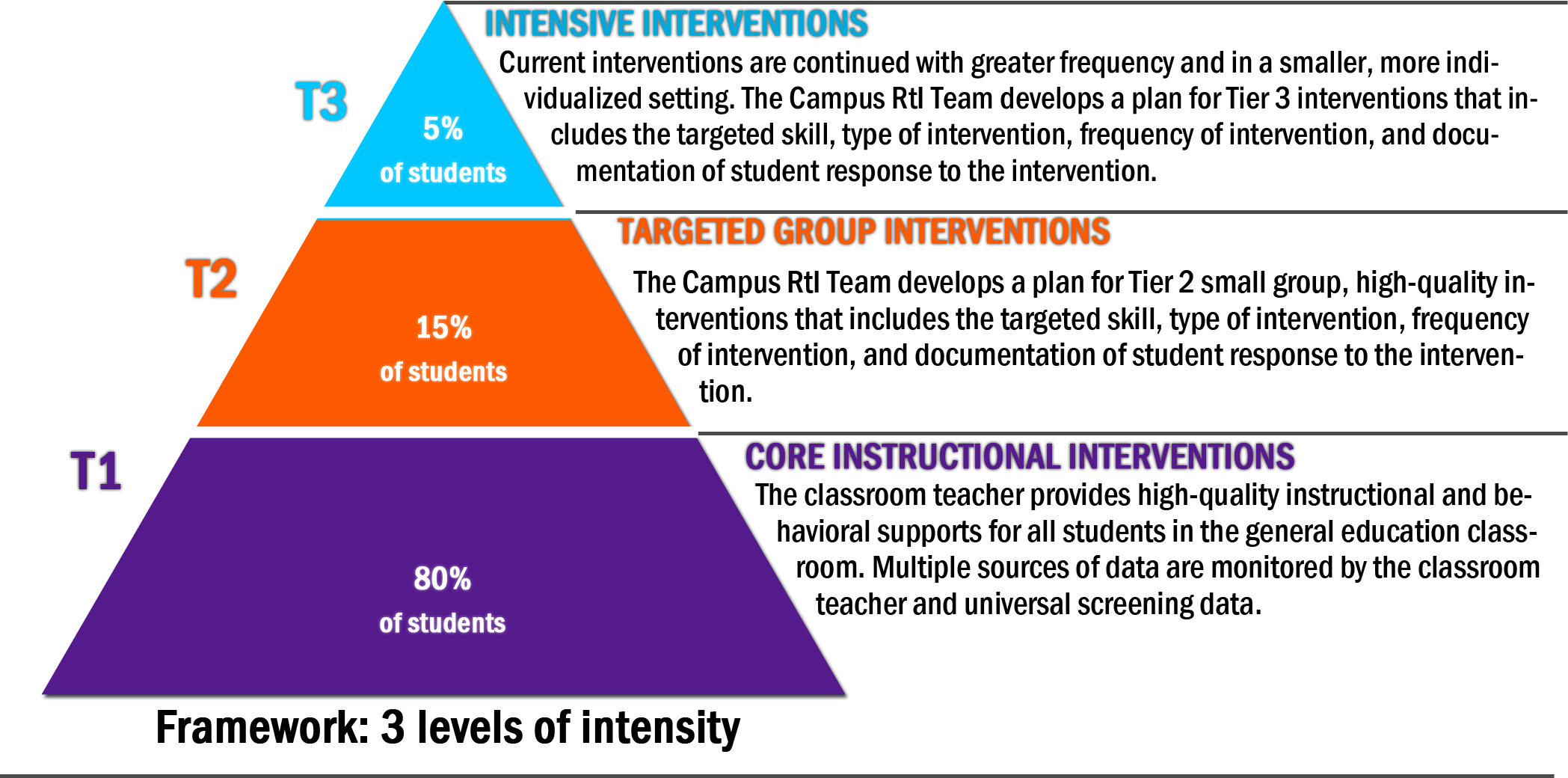
RTI - Response to Intervention is a 3 tiered system.
 -
-
(Image copied from: https://www.smcisd.net/Page/997)
Instruction is given to the entire class by the general education teacher, regardless of which Tier you are in.
Students who need intervention (Tier 2) are placed into a smaller group to get the help they need. That help is more targeted instruction. If a student requires even more targeted instruction, Tier 3, this is a much smaller group and they receive even more targeted intervention.
I really don't have any questions, other than wanting to learn more about the various interventions and how they play out!!
-(Image copied from: https://www.smcisd.net/Page/997)
Instruction is given to the entire class by the general education teacher, regardless of which Tier you are in.
Students who need intervention (Tier 2) are placed into a smaller group to get the help they need. That help is more targeted instruction. If a student requires even more targeted instruction, Tier 3, this is a much smaller group and they receive even more targeted intervention.
I really don't have any questions, other than wanting to learn more about the various interventions and how they play out!!
Tuesday, September 25, 2018
Week 3 Assignment #3
- What is QRI5?
- QRI-5 stands for Qualitative Reading Inventory-5- A number of assessment tools.
- What is the purpose of using QRI5?
- To assess a students comprehension and reading level
- Have you seen similar assessment activities like QRI5? What are they?
- I have seen some of these tools but did not know they were part of QRI5
- What is your impression of QRI5?
- I think it is fantastic and thorough it really hones in on potential problem areas for students and their ability to read and comprehend
Week 3 Assignment #2
Discuss what assessments are needed to measure students' learning outcomes and how teachers can address these common core learning standards if you have students of various reading levels. (Note: This exercise will help you familiarize with Common Core Standards and think about how you can use assessments to inform your instruction.)
These common core standards include a number of fantastic learning outcomes. I would use a Rubric to help me assess each outcome separately, and then assign a final grade. Take for example students working together to create a podcast discussing a literary piece, I would assess each individual student and how the level at which they were involved. I then would also assess the level of understanding the student demonstrated based on the conversation. Lastly I would grade how well a student articulated them selves. Different reading levels pose a challenge but in activities such as this the actual reading is less effected given that it is largely a discussion and an exercise in critical thinking and communication primarily.
Thursday, September 13, 2018
Week 2 Assignment 3
The website Reading Rocket is very informative. It provides very important key information pertaining to how children become excellent and proficient readers. There are a lot of factors which contribute to becoming a great reader (It's Rocket Science ;-)). Young children should be exposed to words and what they look like. Even babies need to be able to distinguish between different types of sounds in order to develop a native language. As they get older children need to be able to understand that letters make sounds and in turn compose words. They then can begin the journey of putting the sounds and letters together to create and read words. They then need to do a ton of practicing and expanding their vocabulary. And then even more practicing to be able to spell words, so that they can appreciate the different words and their differences. Which then can bring us to the purpose, the goal, reading comprehension, the ability to understand the text someone is reading! Each step is foundational and required in order to develop reading comprehension. Without strong reading skills, it is hard to imagine a child doing well in all aspects of life.
Thursday, September 6, 2018
Intro
Hi, I am Rebecca, I have 5 adorable children who drive me crazy ... with love of course .....
my voki link http://tinyurl.com/yboq7fvl
If i were to write a book about myself I would name it: The Life and Journeys of Rebecca Jacobs
My favorite joke is, "One day the teacher asked his students, "Where is G-D" one student replied "in heaven" the other "everywhere" but one shy little boy answered... "he is in the Shower", taken aback the teacher asked him, "the shower? why would you say the shower", the little boy answered: because each morning as we are trying to get ready for school, and my sister is in the shower, my dad bangs on the dorm screaming "LORD ALMIGHTY! GET OUT OF THE SHOWER ALREADY"
I know a bit about language arts and new literacies, and am eager to learn more!
My concerns are that I am a full time Mommy, Teacher, Wife, Nurse, Therapist, Cleaning Lady and cook, only G-D knows how I am going to get all this school work done :D

Subscribe to:
Posts (Atom)